
Submerged Arc Flux Ovens
Improve Weld Quality, Reduce Flux Moisture Contamination, and Maintain Production-Ready SAW Flux
Submerged Arc Welding (SAW) operations depend on one critical factor that is often overlooked: flux condition. Moisture contamination, improper storage, and inconsistent flux handling can negatively impact weld quality, increase rework, and create costly production delays in shipbuilding, pressure vessel fabrication, structural steel manufacturing, and other heavy industrial welding applications.
Keen Submerged Arc (Sub-Arc) Flux Ovens are designed to help fabrication facilities maintain production-ready SAW flux through controlled storage, holding, and rebake processes. By reducing moisture contamination and maintaining proper flux temperatures, these systems help support consistent weld quality, improved deposition efficiency, reduced weld defects, and more reliable welding operations.
Whether storing new flux, conditioning recovered flux, maintaining holding temperatures during production, or performing flux rebake procedures, Keen flux ovens help welding operations protect valuable consumables while supporting compliance-oriented welding practices and demanding quality requirements.
Continue below to learn more about Keen sub-arc flux storage and rebake ovens.
.jpg)
.jpg)
.jpg)
.jpg)
.jpg)
.jpg)
.jpg)
Benefits of Keen Submerged Arc Flux Ovens
- Reduce moisture contamination in submerged arc welding flux
- Improve weld quality and weld deposit consistency
- Support proper SAW flux storage, holding, and rebake procedures
- Reduce weld porosity and moisture-related defects
- Improve first-pass acceptance rates
- Support welding quality assurance programs
- Maintain production-ready flux for continuous welding operations
- Improve consumable traceability and inventory control
- Reduce rework, downtime, and production interruptions
- Support shipbuilding, pressure vessel, structural steel, and heavy fabrication applications
From compact flux holding ovens to large-capacity flux rebake systems, Keen Ovens provides proven solutions for protecting submerged arc welding consumables and helping fabrication facilities achieve more consistent welding results.
.jpg)
.jpg)
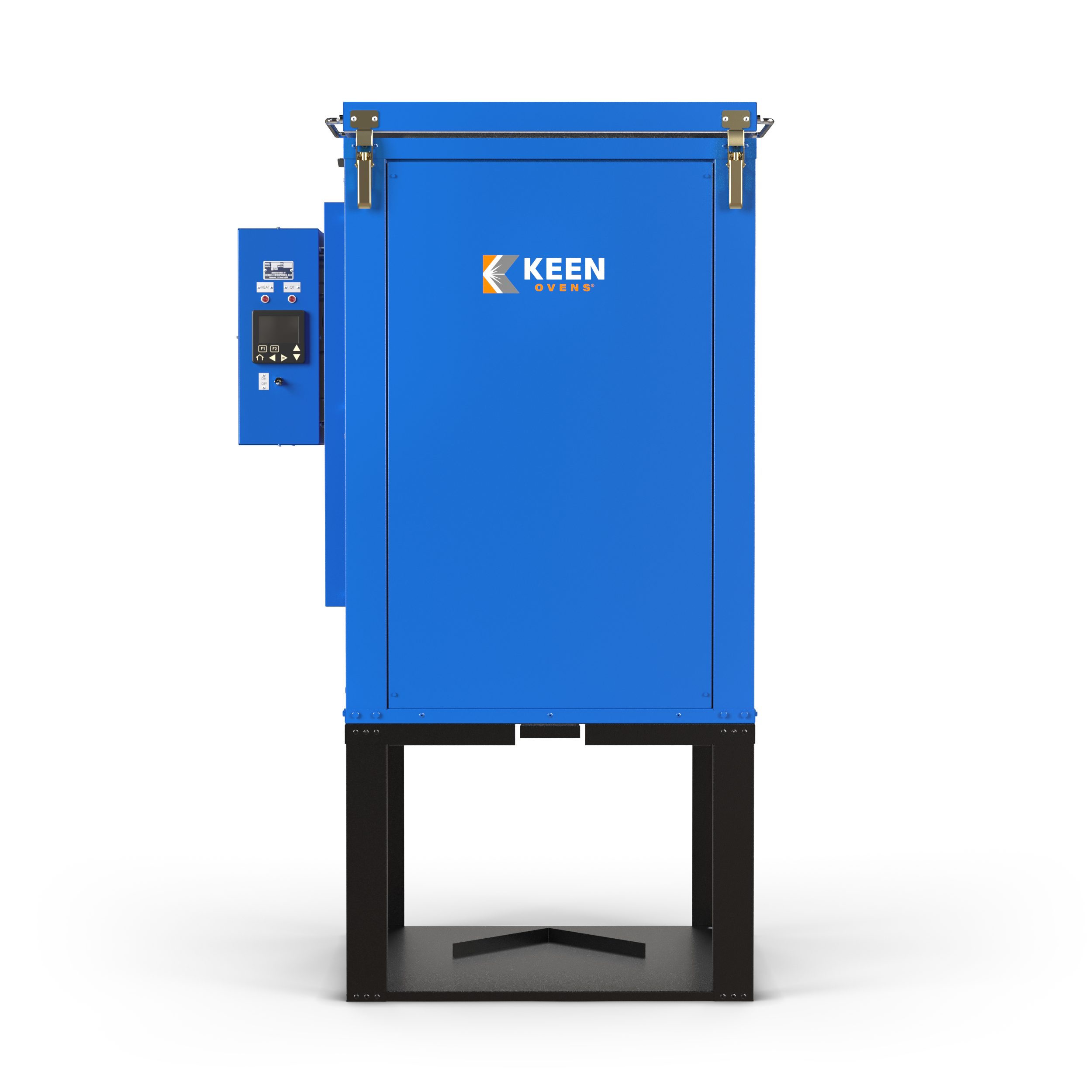

Improve Weld Quality and Mechanical Properties Through Proper Flux Management
In submerged arc welding, flux is much more than a shielding medium. Flux directly influences weld chemistry, arc stability, slag performance, weld appearance, and the mechanical properties of the finished weld. When flux absorbs moisture or becomes contaminated during storage and handling, the effects can appear throughout the welding process and ultimately impact the quality of the finished product.
For shipbuilding, pressure vessel fabrication, structural steel manufacturing, and other critical welding applications, maintaining proper flux condition is an important part of achieving consistent weld quality and predictable mechanical properties.
Why Flux Condition Matters
Submerged arc welding relies on carefully engineered combinations of welding wire and flux to produce specific weld characteristics. Excess moisture or contamination in the flux can interfere with this balance and introduce unwanted variables into the welding process.
Properly stored and conditioned flux helps support:
- Consistent weld chemistry
- Stable arc characteristics
- Uniform slag performance
- Improved weld appearance
- Predictable mechanical properties
- Consistent weld deposit quality
- Improved process repeatability
By maintaining production-ready flux, welding operations can reduce variability and achieve more consistent welding results from shift to shift and project to project.

Support First-Pass Quality
Every weld repair increases labor costs, consumes valuable production time, and creates additional quality control requirements.
Proper flux management helps support:
- Improved first-pass acceptance
- Reduced weld repairs
- Reduced rework
- Improved inspection results
- Greater production efficiency
When welding consumables are properly managed, fabrication facilities can spend less time correcting problems and more time producing quality welds.
.jpg)
Consistent Flux, Consistent Results
Keen Submerged Arc Flux Ovens help fabrication facilities maintain proper flux storage, holding, and rebake conditions to support consistent weld quality and mechanical property performance. By reducing moisture contamination and maintaining production-ready SAW flux, welding operations can improve process consistency, reduce variability, and achieve greater confidence in critical welding applications.
Increase Productivity with Production-Ready Flux
In high-volume submerged arc welding operations, productivity depends on more than welding equipment and skilled operators. Welding throughput is directly influenced by the condition, availability, and management of welding consumables. When flux is not properly stored, conditioned, or readily available, production interruptions can quickly impact schedules, labor utilization, and overall fabrication efficiency.
Production-ready SAW flux helps ensure that welding operations can maintain consistent output without unnecessary delays caused by moisture contamination, consumable shortages, or improper flux handling.
Reduce Welding Downtime
Every production interruption carries a cost. Waiting for flux to be conditioned, locating stored flux, addressing moisture-related welding issues, or managing rework can reduce welding efficiency and disrupt production schedules.
Proper flux management helps reduce downtime associated with:
- Moisture-contaminated flux
- Improper flux storage
- Flux handling delays
- Consumable availability issues
- Rework and repair welding
- Failed inspections
Maintaining production-ready flux helps keep welders welding and projects moving forward.
.jpg)
Reduce Rework and Inspection Failures Through Proper Flux Management
Few issues impact welding profitability more than rework. Every weld repair consumes labor, delays production schedules, increases inspection costs, and reduces overall fabrication efficiency. In high-volume submerged arc welding operations, even a small increase in defect rates can have a significant impact on project costs and delivery schedules.
While many factors contribute to weld quality, flux condition is one of the most overlooked variables in the welding process. Improperly stored, contaminated, or moisture-laden flux can introduce inconsistencies that increase the risk of weld defects and failed inspections.
The Hidden Cost of Welding Rework
When weld defects are discovered, the cost extends far beyond the repair itself.
Rework often results in:
- Additional labor hours
- Increased inspection requirements
- Production delays
- Schedule disruptions
- Lost welding productivity
- Increased consumable usage
- Higher project costs
- Reduced manufacturing efficiency
For shipyards, pressure vessel fabricators, and structural steel manufacturers, rework can quickly become one of the largest hidden costs in the welding operation.
Moisture Contamination Can Create Expensive Problems
Submerged arc welding flux is engineered to produce consistent weld deposits and reliable welding performance. However, when flux absorbs moisture during storage or handling, the resulting weld quality issues may not become apparent until inspection or testing.
Improper flux condition may contribute to:
- Weld porosity
- Slag inclusions
- Hydrogen-related cracking
- Inconsistent weld deposits
- Failed non-destructive examinations
- Reduced mechanical property consistency
- Increased repair rates
Improve First-Pass Acceptance Rates
The most efficient weld is the one that passes inspection the first time.
Fabrication facilities that maintain consistent consumable handling practices often benefit from:
- Improved weld consistency
- Reduced defect rates
- Fewer repair welds
- Improved inspection outcomes
- Increased production efficiency
- Lower overall welding costs
Proper flux storage, holding, and rebake procedures help support first-pass quality by ensuring welding consumables remain in optimal condition throughout production.
.jpg)
Support Quality Assurance Programs
Quality assurance programs are designed to control the variables that influence welding performance. Flux condition is one of those critical variables.
Controlled flux management helps support:
- Consistent welding procedures
- Consumable accountability
- Improved process control
- Better weld repeatability
- Reduced quality-related uncertainty
- Greater confidence during inspections
For QA managers, welding engineers, and inspectors, controlled flux handling demonstrates a commitment to process consistency and welding quality.
Reduce Risk in Critical Welding Applications
In industries such as shipbuilding, pressure vessel fabrication, offshore construction, and structural steel manufacturing, weld failures can have significant consequences.
Proper flux management helps support:
- Reliable welding performance
- Consistent weld quality
- Reduced defect risk
- Improved inspection readiness
- Greater confidence in critical welds
When weld quality is essential, reducing avoidable sources of variability becomes an important part of the overall quality strategy.
Better Flux Management Helps Deliver Better Results
Keen Submerged Arc Flux Ovens help fabrication facilities maintain proper storage, holding, and rebake conditions that support consistent weld quality and improved inspection performance. By helping reduce moisture contamination and maintain production-ready SAW flux, these systems contribute to improved first-pass acceptance rates, reduced rework, and more reliable welding operations.
When fewer welds require repair, productivity improves, costs decrease, and projects stay on schedule.
.jpg)
Support Quality Assurance Programs
Quality assurance programs are designed to control the variables that influence welding performance. Flux condition is one of those critical variables.
Controlled flux management helps support:
- Consistent welding procedures
- Consumable accountability
- Improved process control
- Better weld repeatability
- Reduced quality-related uncertainty
- Greater confidence during inspections
For QA managers, welding engineers, and inspectors, controlled flux handling demonstrates a commitment to process consistency and welding quality.
Improve Inventory Accountability and Traceability
As welding operations grow, managing large volumes of welding consumables becomes increasingly challenging.
Centralized flux storage systems help support:
- Better inventory control
- Improved consumable accountability
- Enhanced traceability
- Reduced inventory confusion
- Improved stock management
- Faster consumable access
Improved inventory visibility helps fabrication facilities maintain tighter control over consumable assets while supporting quality assurance objectives.
Protect Against Production Interruptions
Consumable-related production delays can quickly impact schedules and profitability.
Maintaining properly stored, production-ready flux helps reduce the risk of interruptions caused by:
- Moisture-contaminated flux
- Inadequate consumable availability
- Improper flux handling
- Flux quality concerns
- Emergency consumable replacement
When flux is protected and readily available, production teams can focus on welding rather than consumable problems.
Protect Valuable Flux Inventory Through Proper Storage and Handling
Submerged arc welding operations often maintain significant inventories of new and recovered flux to support continuous production. Whether supporting shipbuilding, pressure vessel fabrication, structural steel manufacturing, or heavy industrial welding, welding flux represents a substantial investment that directly impacts productivity, weld quality, and operating costs.
Without proper storage and handling procedures, flux can become contaminated, absorb moisture, or deteriorate in condition before it ever reaches the weld zone. Protecting flux inventory helps fabrication facilities maximize consumable value while supporting more consistent welding performance.
Preserve the Quality of New Flux
New submerged arc welding flux is carefully manufactured to meet specific performance requirements. Exposure to humidity, moisture, dirt, oils, or other contaminants can compromise those characteristics and introduce unnecessary variability into the welding process.
Proper flux storage helps preserve:
- Flux integrity
- Moisture-resistant condition
- Weld deposit consistency
- Mechanical property performance
- Welding process reliability
- Consumable value
Maintaining controlled storage conditions helps ensure flux performs as intended when it reaches production.
Reduce Consumable Waste
Every pound of unusable flux represents lost value.
Improper storage practices can contribute to:
- Moisture contamination
- Material spoilage
- Increased flux disposal
- Excessive flux replacement costs
- Inventory losses
By maintaining proper storage, holding, and rebake procedures, fabrication facilities can reduce unnecessary consumable waste and improve overall material utilization.
Improve Recovered Flux Management
Many submerged arc welding operations recover and reuse flux as part of normal production. While recovered flux can provide significant economic benefits, it also requires proper handling to maintain quality and consistency.
Controlled flux management helps support:
- Recovered flux conditioning
- Improved flux consistency
- Reduced contamination risk
- Better inventory organization
- Improved process repeatability
A structured flux management program helps maximize the value of both new and recovered flux inventories.

Submerged Arc Flux Ovens for Shipbuilding, Pressure Vessel Fabrication, and Heavy Manufacturing
Submerged Arc Welding (SAW) is one of the most productive and widely utilized welding processes in heavy industrial fabrication. From shipyards and pressure vessel manufacturers to structural steel fabricators and heavy equipment producers, submerged arc welding is relied upon to produce high-quality welds on thick materials where productivity, weld integrity, and process consistency are essential.
Regardless of the industry, one factor remains constant: weld quality begins with properly managed welding consumables. Maintaining production-ready flux through proper storage, holding, and rebake procedures helps support consistent welding performance, improved weld quality, and reduced production risk across a wide range of critical fabrication applications.
Shipbuilding and Naval Fabrication
Shipyards represent some of the largest users of submerged arc welding in the world. SAW is commonly utilized for hull sections, deck structures, stiffeners, bulkheads, foundations, and other large welded assemblies where long weld seams and high deposition rates are required.
Because shipbuilding environments are often exposed to humidity, moisture, and changing weather conditions, maintaining proper flux condition is an important part of controlling welding quality.
Keen Submerged Arc Flux Ovens help shipyards:
- Reduce flux moisture contamination
- Support welding quality assurance programs
- Maintain production-ready SAW flux
- Improve weld consistency across multiple shifts
- Reduce weld repairs and rework
- Improve consumable traceability and inventory control
For naval and commercial shipbuilding operations, proper flux management helps support the consistent welding practices required for mission-critical structures and demanding production schedules.
Pressure Vessel and Process Equipment Fabrication
Pressure vessel manufacturers depend on submerged arc welding for the fabrication of heavy-wall vessels, storage tanks, heat exchangers, pressure-retaining components, and process equipment used throughout the energy, petrochemical, and industrial processing sectors.
In these applications, weld quality, mechanical property performance, and code compliance are critical.
Properly conditioned flux helps support:
- Consistent weld deposits
- Improved mechanical property performance
- Reduced welding defects
- Improved first-pass acceptance rates
- Greater process repeatability
- Reduced rework and inspection failures
Maintaining proper flux storage and rebake procedures helps pressure vessel fabricators control important welding variables while supporting quality-focused manufacturing operations.
Structural Steel and Bridge Fabrication
Submerged arc welding is widely used for structural steel components, bridge girders, columns, box sections, and other heavy fabricated assemblies where high deposition rates and long weld lengths make SAW an efficient production process.
For structural fabricators, maintaining proper flux condition helps support:
- Consistent weld quality
- Reduced weld repairs
- Improved production efficiency
- Better process control
- Improved inspection performance
- Greater confidence in critical structural welds
Production-ready flux helps ensure welding operations remain productive while supporting the quality standards required for large infrastructure projects.
Heavy Industrial Manufacturing
Manufacturers of mining equipment, railcars, wind towers, offshore structures, heavy machinery, and industrial equipment frequently utilize submerged arc welding to achieve the productivity and weld quality required for large-scale fabrication.
These operations often maintain significant inventories of new and recovered flux to support continuous production.
Keen Submerged Arc Flux Ovens help heavy manufacturing facilities:
- Protect valuable flux inventory
- Improve consumable management
- Reduce moisture-related welding issues
- Improve welding productivity
- Support continuous production operations
- Reduce costly production interruptions
Proven Solutions for Demanding SAW Applications
Whether supporting shipbuilding, pressure vessel fabrication, structural steel manufacturing, or heavy industrial production, Keen Submerged Arc Flux Ovens help maintain production-ready SAW flux through controlled storage, holding, and rebake processes. By helping fabrication facilities manage moisture, protect consumables, and maintain consistent welding conditions, Keen ovens support the weld quality, productivity, and reliability demanded by today's most challenging submerged arc welding applications.

Frequently Asked Questions
Please read the following FAQ section for more information about KEEN flux ovens, as well as individual product overviews and specifications for the various subarc flux ovens we manufacture at KEEN.
What is subarc flux and what is submerged arc welding (SAW)?
Submerged arc welding (SAW) is a common welding process that is frequently used in the structural and vessel construction industries. The process requires a tubular or consumable solid electrode that is continuously fed into the work area using fully-automatic or semi-automatic methods. As the electrode is fed into the arc and melted, a layer of granular material provides a protective cover beneath which the welding occurs. Called flux, this fusible material consists of lime, silica, manganese oxide, calcium fluoride, and other compounds. The flux forms a hardened layer after it is heated and becomes molten. In this melted state the flux becomes conductive, thus enabling it to supply a constant current between the electrode and the welding work. The remainder of the flux is recovered and reused, unless it has become contaminated.
The granular flux used in SAW serves several functions. In addition to providing a protective cover over the weld, the flux shields and cleans the molten puddle. The flux also affects the chemical composition of the weld metal, the weld bead shape, and the mechanical properties of the weld. Another function of granular flux is to act as a barrier that contains and concentrates the heat into the weld area thus enabling deeper weld penetration.
Why do I need to store subarc flux in a heated oven?
In order to answer this question, it is pertinent to describe the four types of welding fluxes that are commonly available: fused, bonded, agglomerated and pre-mixed fluxes.
Fused — this type of flux is non-hygroscopic (does not absorb moisture from the air). Any surface moisture on the particles can be removed at a low temperature oven setting of 300°F.
Bonded — this type of flux is hygroscopic (absorbs moisture from the air) and is comprised of a combination of dry ingredients that are glued together with a liquid binder, then baked at a low oven temperature.
Agglomerated — this type of flux is hygroscopic and is manufactured the same way as bonded fluxes only a ceramic binder is used instead of a liquid binder.
Pre-Mixed — this type of flux is hygroscopic and is simply a combination of two or more bonded or agglomerated fluxes.
Just as stick welding electrodes readily pick up moisture from the surrounding atmosphere, the same applies to bonded welding fluxes that are comprised mostly of dry, powdered ingredients. As described above, the purpose of flux is to clean and shield the weld area from impurities. If moisture has contaminated the flux, hydrogen is released into the metal when heat is applied. When the weld cools, it can become brittle, crack and/or develop pinholes. Moisture-contaminated flux can also accelerate corrosion to certain metals like aluminum and must be kept dry throughout the welding process.
Welding flux holding ovens and rebake ovens are an indispensable addition to any subarc welding operation to help ensure quality welds. Our flux holding ovens and rebake ovens are suitable for almost any flux heating application that is required for today’s professionals.
What are the proper storage and rebaking guidelines for subarc flux?
For specific storage and rebake temperature guidelines, we recommend contacting the welding consumable manufacturer directly. It is also important to check with local welding codes and/or ask a welding inspector to provide some information. Welding standards change frequently, and each manufacturer often provides a different recommendation regarding welding consumable storage. Check the packaging and also manufacturer websites for information. Keen offers a wide range of products to handle almost any welding consumable storage requirement.
What is the difference between subarc flux holding/storage and subarc flux rebaking/reconditioning?
Generally, there are two involved with the proper maintenance of subarc welding flux: holding (also called storing) and rebaking (also called reconditioning).
The holding process refers to the long-term* heated storage of welding flux to maintain factory-fresh dryness. Storing the flux at elevated temperatures prevents atmospheric moisture contamination of the hygroscopic granules. There are various temperature requirements according to the type of flux and also that are also set forth by welding codes. For specific holding temperature guidelines, please contact the manufacturer of your welding consumable.
The rebaking process refers to the short-term*, high temperature heating of subarc flux that has been contaminated by atmospheric moisture. The rebaking process “reconditions” the welding flux, meaning it bakes out the moisture that has been absorbed thus restoring the flux so it is suitable for reuse. For specific rebake temperature guidelines, please contact the manufacturer of your consumable.
* - In relation to our products, we consider long-term to mean 24 hours/day 7 days/week.
What are the key differences between welding flux holding ovens and welding flux rebake ovens?
Keen ovens are specifically designed according to the temperature range of the process, and the amount of subarc flux to be stored. The standard holding ovens are designed to accommodate a maximum temperature of 550F and the rebake ovens are designed to reach 999F. The higher temperature ovens have larger wall thicknesses to accommodate more insulation and digital programmable temperature controllers. More information is available on the individual product pages. Please select a product from the chart above and you will be taken to the product page which has digital photos of each flux oven and technical specifications.
How can I determine the amp draw for a particular model?
Use this formula: Watts / Voltage = Amps
Related Categories
.jpg)
.jpg)
.jpg)


contact our experts
Our staff is available to answer any questions, or locate a Keen distributor in your area.
Give us a call at 1-888-512-2870 or send us a message and our team will be in touch shortly!
*denotes a required field.